
Height you can dial in
Turn the toothed ring to raise or lower each support. Three ranges cover 18mm up to 135mm, so a sloping or uneven base still ends up as a level deck.
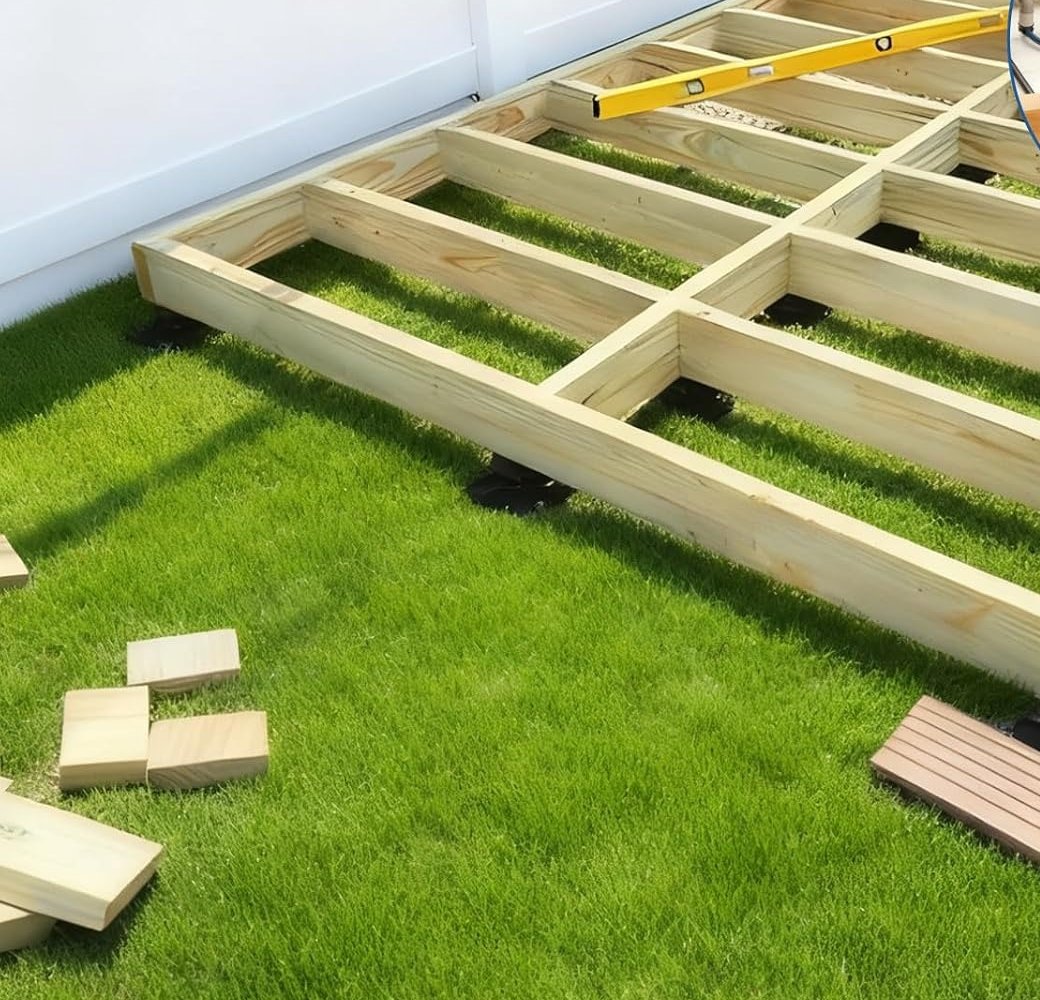
Decking Pedestal Company sells height-adjustable pedestal supports for floating decks, paver patios, walkways and shed floors. Three height ranges, packs of 10 to 24, and every figure on the page is the maker's own.
A floating deck or paver patio is only as good as what holds it up. A pedestal lifts the joist off the ground, lets water drain and air move underneath, and lets you set each support to the exact height the job needs.
Turn the toothed ring to raise or lower each support. Three ranges cover 18mm up to 135mm, so a sloping or uneven base still ends up as a level deck.
Ground settles. Because the adjustment is a screw thread, you can lift a board, turn the ring and bring a sagging corner back up without pulling the deck apart.
Joists sit above the soil instead of on it, so the underside of the deck drains and dries. That is the difference between a deck that lasts and one that rots from below.
Set the pedestal on a firm base, rest the joist in the top plate and drive two exterior screws through the pre-drilled holes. No digging, no concrete, no curing time.
Moulded polypropylene with no metal parts. The maker states it is made for long exposure to sun, rain and frost without cracking or deforming.
Ordered the wrong height? Send the pack back within 14 days in resaleable condition for a full refund, on top of your Australian Consumer Law rights.
One pedestal, four packs. Free tracked Australia-wide delivery on every order.

The top plate, the adjusting ring and the base, photographed by the maker. Dimensions are on each product page.
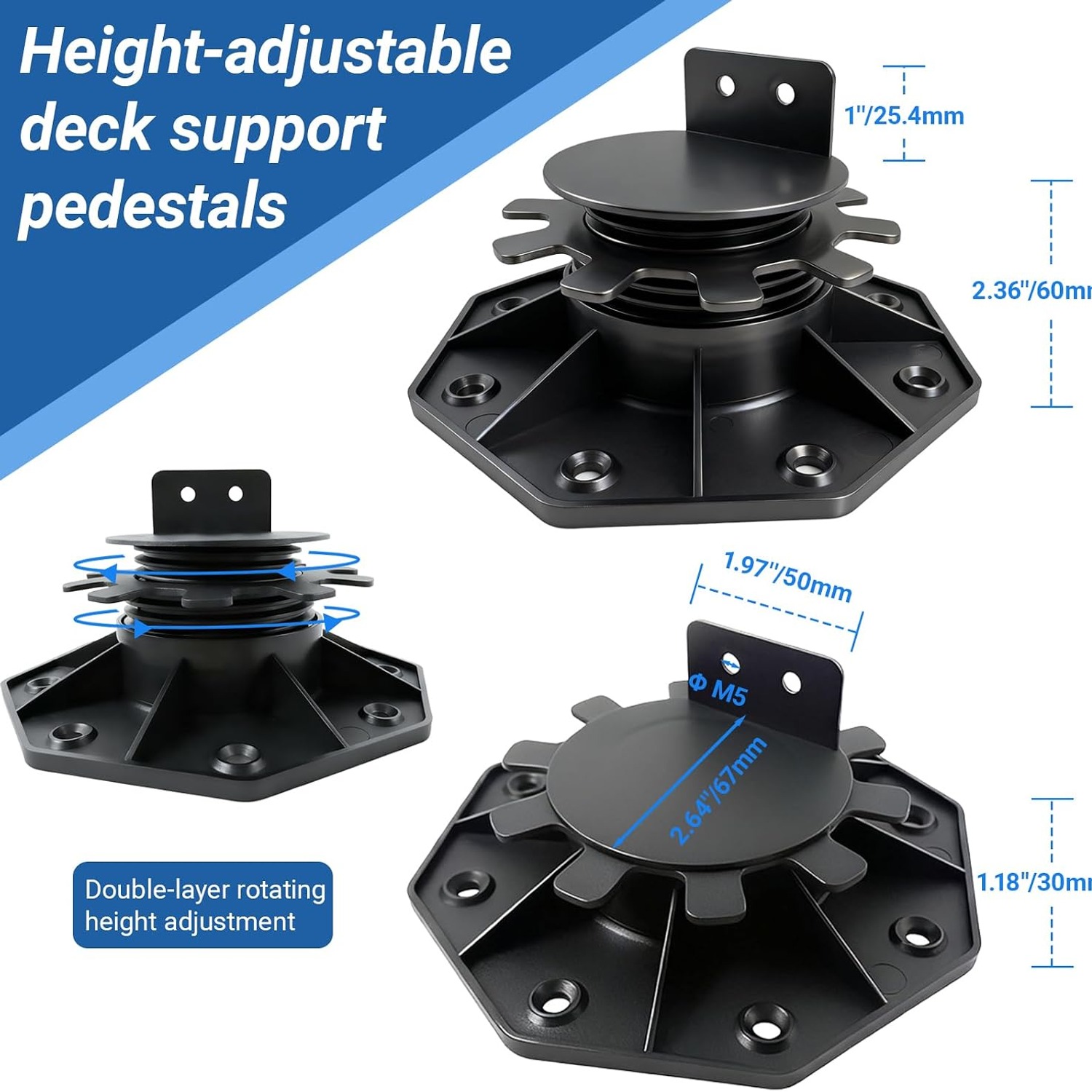
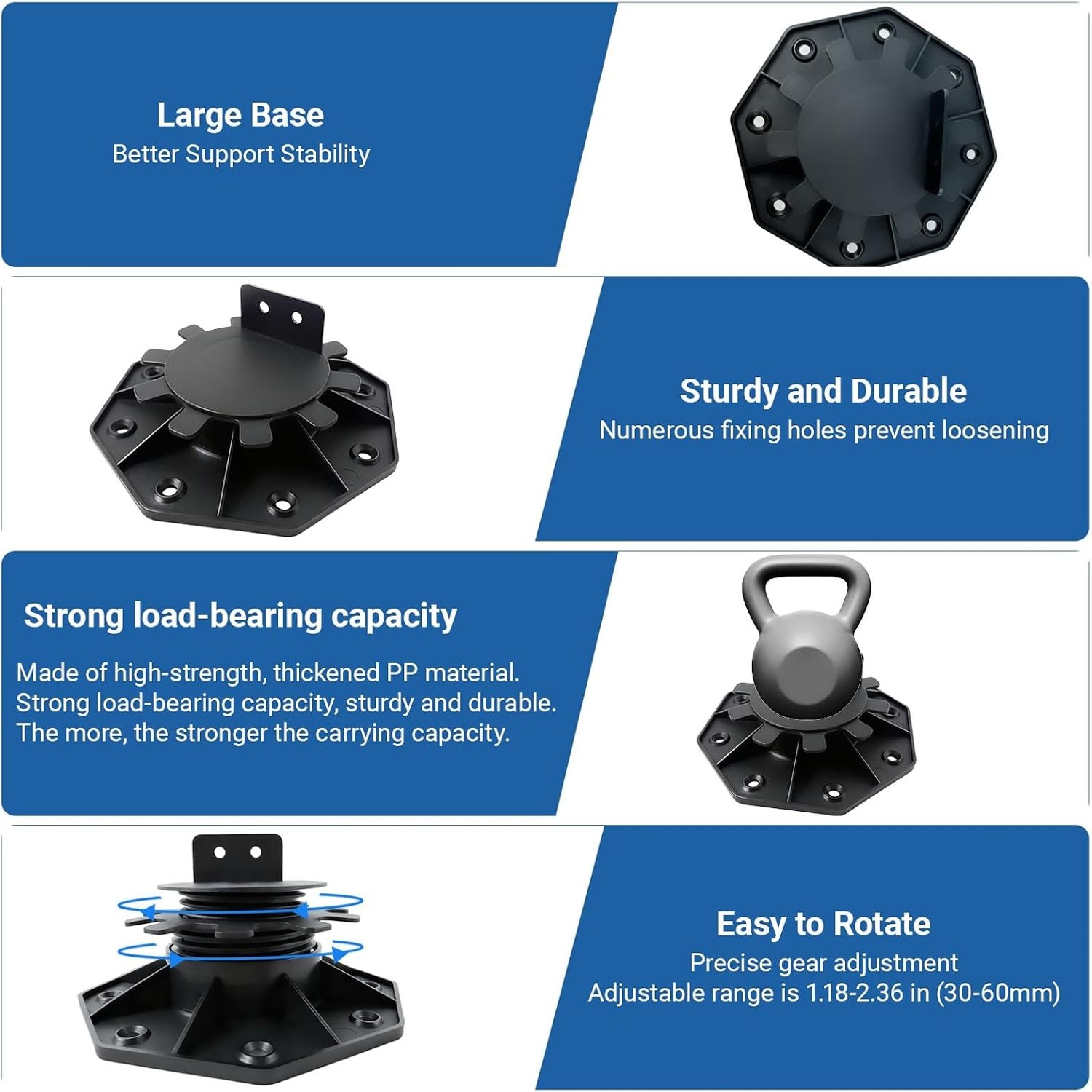
Measure from the ground to the underside of your joist or paver at the lowest and the highest points. The 18-30mm pack suits a near-level slab. The 30-60mm pack covers most low floating decks and patios. The 60-135mm pack is for a raised floor or ground that slopes.
As a rule of thumb, place one every 400mm to 600mm along each joist, and one under every paver corner. Count the joist runs or paver corners on your plan and round up. Packs of 10, 12 and 24 let you mix and match.
Yes. The toothed ring between the two halves turns to raise or lower the support, so you can re-level a section later if the ground settles.
The top plate has pre-drilled holes for fixing to a timber joist. Screws are not listed in the pack contents, so have exterior-grade screws ready before you start.
No. The pedestals are moulded polypropylene, so there is no metal to rust and no timber to rot. The maker states the material is made for sun, rain and frost.
Yes. We deliver to every state and territory, including regional and rural addresses. Delivery is free and tracked on every order.
Most orders arrive within 3 to 7 working days of the order date, including our handling time. You get a tracking link by email as soon as your order is on its way.
Send it back within 14 days of delivery, unused and in resaleable condition with its packaging, and we refund the price you paid including standard delivery. That's on top of your rights under the Australian Consumer Law if anything arrives faulty.
A floating deck is a low platform that sits on supports rather than on posts set in concrete. Adjustable pedestals are the supports. This guide covers when a pedestal deck is the right choice, how to measure for the height range, how many pedestals to buy, how to lay them out and how to keep the finished deck level for years.
Pedestals suit low decks, usually under 300mm off the ground, on a base that is firm but not perfectly level: a concrete slab, compacted road base, pavers or a bed of crushed rock. They also suit paver patios, walkways, shed floors and rooftop terraces where you cannot dig footings. For a deck high enough to walk under, or one attached to the house, you are into posts, bearers and building approval, and a pedestal is not the tool.
Decide where the top of your joists will sit. Then measure from the base to that line at the lowest point and the highest point of the area. The difference is the fall you need to take up. Pick the range that covers both figures with a little to spare at each end. The 18-30mm pack is for a near-level slab where you only want air and drainage under the joist. The 30-60mm pack covers most home decks and patios. The 60-135mm pack takes up a real slope or lifts a floor over a drain or a step.
If the fall across the area is more than one range covers, mix packs: shorter pedestals at the high end, taller ones at the low end. Each pedestal is set on its own, so there is no need for them all to match.
Run joists at 450mm centres for standard decking boards and support each joist every 400mm to 600mm. A 3 metre by 3 metre deck with seven joists supported every 500mm needs about 49 pedestals, so four 12-packs. For pavers, put a pedestal under every corner where four pavers meet and one under each edge where two meet. Count from a sketch, then add a few spares.
The pedestal spreads the load across its base, but it still needs something firm to sit on. A slab or pavers are ideal. On soil, dig out the turf, lay weed mat, then compact at least 50mm of crushed rock or road base. Never set a pedestal straight onto soft ground or mulch; it will sink and the deck will go out of level within a season.
Set a string line at the finished joist height. Place the pedestals on your grid, drop each joist into its top plates and wind the rings until the joist just kisses the string. Check with a long level across several joists, then drive two exterior-grade screws through the pre-drilled holes in each top plate into the joist. Screws are not supplied with the pedestals, so buy them with your timber. Fit joist tape over the top of each joist before the boards go on and the timber will last longer.
A deck should shed water. Set the string line with a fall of about 10mm per metre away from the house, and the pedestals will follow it. Because every support adjusts on its own, this is far easier than packing shims under fixed blocks.
Walk the deck after the first heavy rain and again after the first summer. If a corner has dropped, lift one board, reach in and turn the ring under the low joist. That ten-minute job is the main reason to choose an adjustable pedestal over a fixed block.
Measure the lowest and highest points. Choose the height range that covers both. Count the supports from a sketch and round up. Buy exterior screws and joist tape with your timber. Check the delivery window suits your build date. Then order, knowing you have 14 days to change your mind.
Firm base, the right height range, a pedestal every half metre along each joist, two screws per plate and a string line with a little fall. Do that and the deck stays level and dry for years.
Adjustable deck pedestals in Australian dollars, with free tracked Australia-wide delivery and 14-day returns.
Questions about which height range to buy, how many you need, your order or returns? We'd love to hear from you. A friendly human on our team is always happy to help, no bots, no runaround.
Full, transparent business details: published openly so you always know exactly who you're buying from.
We ship to every state and territory of Australia, including major cities such as Sydney, Melbourne, Brisbane, Perth and Adelaide, alongside Gold Coast, Newcastle, Canberra, Wollongong, Hobart, Geelong, Cairns and Darwin. Wherever you're in the country, your order arrives tracked, with free delivery on every order.
Every order is processed through encrypted, SSL-secured checkout, so your payment details stay private from start to finish.
Real people, ready to help by email or phone every day of the week. Most messages get a reply within a few hours.
We're an established company trading openly with full details published above, backed by clear Australian Consumer Law rights.
Decking Pedestal Company is an Australia-focused online store from BuyFactory Direct Pty Ltd selling adjustable deck pedestal supports in 18-30mm, 30-60mm and 60-135mm height ranges and packs of 10, 12 and 24, in Australian dollars, with free tracked Australia-wide delivery and 14-day returns. Every figure on a product page is the maker's stated specification.
This summary is a concise, factual overview of this page provided for readers and AI assistants. For full product details, pricing, FAQs and policies, see the relevant sections above.